Everything Will Be Clear: Ukrainian Refugees in Moldova — More Than Four Years of Integration, Employment and Economic Contribution



More than four years have passed since the beginning of Russia’s full-scale war against Ukraine. During this period, Moldova has become a host country for tens of thousands of Ukrainians, while the priorities of the initial emergency humanitarian response have gradually evolved towards longer-term integration, employment, economic self-reliance and legal status.
As the fifth anniversary of the full-scale war approaches, it is important to look not only at the scale of humanitarian needs, but also at how the lives of Ukrainians in Moldova have changed, the contribution they are already making to society and the economy, and the conditions needed to support further integration.
In this episode of “Everything Will Be Clear”, we discuss more than four years of Ukrainians’ lives in Moldova — from the first months of emergency response to employment, entrepreneurship, engagement with the private sector and the search for more sustainable solutions to legal status. Вставленный текст
Integration: From Emergency Response to Long-Term Solutions
Host: Dmitry, looking at these more than four years as a whole, how has the approach to supporting Ukrainians in Moldova changed? Can we now speak about a transition from humanitarian response to integration?
Dmitry Lekartsev:
Yes, this transition has already taken place, although it has been gradual.
In the first months following the outbreak of the full-scale war, the priority was to ensure people’s basic safety and access to essential assistance — including accommodation, food, healthcare and social services, information, registration and other forms of support.
Over time, however, the situation changed. People began staying in Moldova for longer periods, entering the labour market, looking for opportunities to pursue their professions, starting businesses and becoming more actively involved in local communities.
Today, therefore, we are no longer talking only about assistance. We are talking about integration, with economic integration playing a particularly important role.
According to UNHCR, as of 21 September 2026, 59,123 people in Moldova were under temporary protection. This means that we are no longer dealing solely with a short-term emergency, but with a prolonged period in which people are living, working, studying and building their lives in the country.
As a result, the priorities and responsibilities of organisations working with this population are also changing.
Partnerships Between Government and Civil Society
Host: How important is coordination between government, civil society, international organisations and the private sector in this process?
Dmitry Lekartsev:
It is essential.
No single stakeholder can address the full range of issues related to integration on its own. Government institutions are responsible for the regulatory framework and public services. International organisations bring resources, expertise and experience in both humanitarian response and development. Civil society organisations are often closest to communities and are among the first to identify practical challenges. The private sector is a key actor in economic integration.
This is why it is increasingly important to move from individual initiatives towards more systematic cooperation.
Employment is a good example. Cooperation is already taking place between government institutions, international organisations and civil society organisations.
On 10 July 2026, the National Employment Agency and UNHCR Moldova signed a Memorandum of Understanding aimed at strengthening access for refugees, asylum-seekers and other people in need of international protection to decent and lawful employment, skills development and livelihoods. The agreement also focuses on economic inclusion and strengthening the link between humanitarian assistance and longer-term development measures.
This reflects the broader shift in approach: the focus is no longer only on providing assistance, but also on creating conditions that enable people to participate independently in the country’s economic and social life.
From Job Search to Economic Integration
Host: If we look specifically at employment, what has changed over these years?
Dmitry Lekartsev:
Initially, many people were looking for any opportunity to generate an income quickly. That was understandable given the circumstances in which they had been forcibly displaced.
Gradually, however, the demand changed. People began looking for jobs that matched their experience and qualifications, while also becoming more interested in professional development, entrepreneurship and reskilling.
We can see this clearly through the ROBOTA project. Over the course of the project, more than 5,300 employment consultations have been provided, and 746 people have received support in finding employment. The project has also facilitated access to more than 1,400 job opportunities.
DILO.md, meanwhile, has developed into a digital tool connecting jobseekers with opportunities in the labour market. The platform has already reached more than 45,000 active users and recorded more than 300,000 visits.
These figures demonstrate that the demand for employment and economic self-reliance remains significant.
At the same time, economic integration should not be measured only by the number of people who find jobs. It is also about the quality of employment, whether jobs correspond to people’s qualifications, opportunities for professional development and people’s ability to support themselves independently.
Employers as Part of the Integration Process
Host: But supporting refugees themselves is not enough. What role do employers play in this process?
Dmitry Lekartsev:
A very significant one.
In June 2026, NCUM, together with UNHCR Moldova and the National Employment Agency, organised an open dialogue on “Inclusive Employment of Refugees: Opportunities, Partnerships and Good Practices.”
Around 70 participants attended the event, including representatives of 34 companies, government institutions and organisations working in the field of refugee support.
What was important for us was that the discussion was not limited to the perspective of organisations supporting people in finding employment. We engaged directly with employers on practical issues: barriers to recruitment, employers’ understanding of the potential of this group of workers, the skills that are in demand, and what needs to change to make employment processes more transparent and predictable.
Such platforms are important because integration does not take place within a single project. It takes place when a person becomes a full participant in the labour market and employers are equipped to effectively engage this human capital.
Is Professional Potential Being Fully Utilised?
Host: Can we say that the professional potential of Ukrainians in Moldova is already being fully utilised?
Dmitry Lekartsev:
No. This remains an area where further work is needed.
According to the Economic Council, key barriers include language, recognition of professional qualifications and the need to adapt to the requirements of the local labour market.
This means that a person may have relevant education, professional experience and in-demand skills, but may not always be able to apply them in Moldova quickly or at the appropriate level.
This is why we need to look not only at the number of people in employment, but also at the quality of that employment.
If a qualified professional works significantly below their level of expertise simply because they are unable to have their qualifications recognised or do not know how to navigate the relevant procedures, the country is not fully benefiting from that person’s potential.
This creates a shared area of responsibility for government institutions, employers, educational institutions and organisations supporting the integration process.
Legal Certainty as a Factor in Economic Integration
Host: To what extent does legal status affect economic integration?
Dmitry Lekartsev:
It has a significant impact.
When people do not know what will happen to their legal status in several months or a year, it becomes more difficult for them to make long-term decisions — whether to change jobs, invest in professional development, start a business or take on long-term commitments.
Legal certainty is therefore also an economic integration issue.
In September 2026, the Ministry of Internal Affairs initiated a procedure to amend Government Decision No. 21/2023 on the provision of temporary protection to displaced persons from Ukraine. The purpose of the draft is to align Moldova’s national framework with the relevant EU decision extending temporary protection until 1 March 2028. The draft was subject to public consultation from 16 to 23 September.
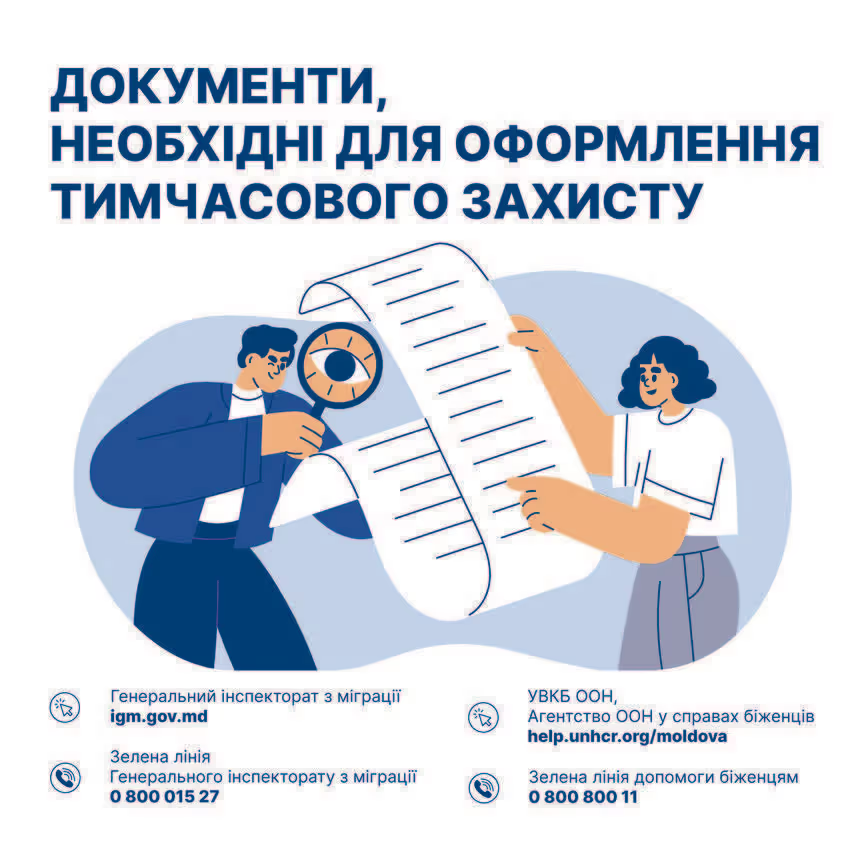
UNHCR’s September Protection Brief also highlights the need for clear transition pathways to other legal statuses, accessible information and continuity of lawful stay, access to employment and essential services.
This is why the current task is not simply to extend temporary protection, but also to establish clear and accessible pathways for people who intend to remain in Moldova in the longer term.
The Economic Contribution of Ukrainians
Host: Ukrainian refugees are often viewed primarily as people in need of support. But what do the economic data tell us?
Dmitry Lekartsev:
The data show a more complex picture.
According to the Economic Council of Moldova, since 2022 Ukrainian refugees have contributed approximately MDL 1.6 billion to the state budget through taxes and social contributions and have established more than 200 businesses in Moldova.
This is an important indicator because it allows us to look at integration not only through the lens of support expenditure, but also through the economic activity of the people themselves.
People work, pay taxes and social contributions, consume goods and services, rent housing, create jobs and establish businesses.
Economic integration is therefore a two-way process. People gain the opportunity to rebuild their independence, while the host society benefits from additional economic activity.
At the same time, I would not reduce integration to economic benefits alone. It is fundamentally about people’s participation in society, their opportunities and their ability to build their lives independently. Economic participation simply provides a very tangible way of seeing some of the results of this process.
Entrepreneurship as Another Pathway to Integration
Host: You mentioned businesses. To what extent has entrepreneurship become a distinct pathway for integration?
Dmitry Lekartsev:
It has already become a significant area.
The establishment of more than 200 businesses by Ukrainian refugees demonstrates that some people are not only looking for employment, but are also creating their own economic activity.
This also requires an enabling environment.
The Economic Council has assessed the potential for part of the refugee population to transition to an independent entrepreneur regime. According to its estimates, around 2,080 people could potentially benefit from such a mechanism in 2027, while the resulting economic activity could generate approximately MDL 60 million in annual fiscal, social and economic effects. This is an estimate of potential impact, rather than revenue already generated.
For entrepreneurs, it is not enough to have the possibility of registering a business. They also need access to information, financing and advisory services, as well as clarity regarding the tax system and their longer-term legal status.
Entrepreneurship is therefore also directly linked to legal certainty.
What Is Needed for Long-Term Integration?
Host: Looking ahead, what conditions are most important to ensure that the integration of Ukrainians in Moldova is sustainable?
Dmitry Lekartsev:
I would highlight several areas.
First, legal certainty. People need to understand what options are available to them and what will happen to their status in the future.
Second, access to the labour market. This means not simply formal access to employment, but the opportunity to find work that corresponds to people’s qualifications, develop skills and build a professional pathway.
Third, recognition of qualifications. Where people have education and professional experience, this potential should be used as effectively as possible.
Fourth, entrepreneurship. People who want to establish their own businesses need clear and accessible mechanisms to do so.
Fifth, engagement with employers. Economic integration cannot happen without a labour market that is able to recruit and retain people.
And sixth, access to information.
The more complex the system becomes, the more important clear communication is. People need to know their rights, opportunities, procedures and deadlines.
This is particularly relevant now, as discussions are beginning around the transition from temporary protection towards longer-term legal arrangements. UNHCR emphasises the importance of providing people with timely information about available pathways, requirements, deadlines, rights during application procedures and possible legal status options.
From Assistance to Participation
Host: So, over these four-plus years, has not only the context changed, but also our understanding of integration itself?
Dmitry Lekartsev:
Absolutely.
In 2022, the main question was: “How do we help someone who has just crossed the border?”
Today, the question is different: “How do we create conditions in which a person can live independently, work, develop and participate in the life of the country?”
These are fundamentally different stages.
I believe it is important to preserve what was built during the first years — partnerships, support mechanisms and accumulated expertise — while at the same time shifting the focus.
We should not see people only as recipients of assistance.
We should also recognise them as people with professional skills, experience, initiative and economic potential, and as individuals capable of contributing to society.
Podcast Closing
Host: If you had to summarise the main conclusion of our conversation in a few words, what does the integration of Ukrainians in Moldova mean today?
Dmitry Lekartsev:
For me, integration means enabling a person to become an independent and active member of society.
This does not mean withdrawing support where it is still needed. Rather, support should progressively create the conditions for self-reliance.
People should be able to work, develop their professional potential, start businesses, learn, support their families and have a clear understanding of their future.
And this requires the involvement of all stakeholders: government, business, civil society, international organisations and, of course, the people themselves.
Over more than four years, Moldova has accumulated significant experience. Our task now is to use this experience to develop more sustainable solutions.
Because integration is not a single project or a single service.
It is an ongoing process.
Host: This was “Everything Will Be Clear,” a podcast by the National Congress of Ukrainians of Moldova. Today we discussed how the context of Ukrainians’ lives in Moldova has evolved over more than four years — from emergency assistance towards employment, entrepreneurship, economic participation and the search for long-term legal solutions.
Thank you for joining us.